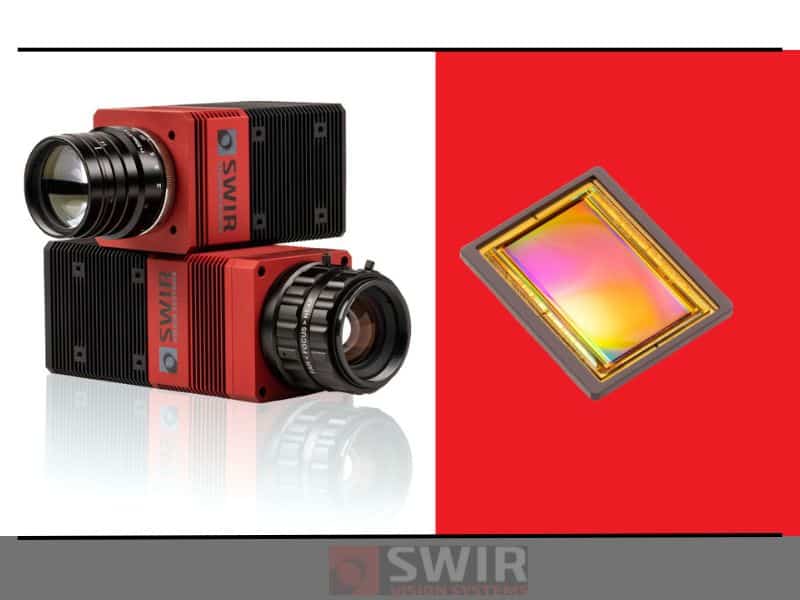
For an imager, the purpose of the optic is to gather light, transmit as much as possible in the desired spectral band, and focus the rays on the correct points of the sensor. Many optical properties inherent to visible lenses can have severe consequences on image quality with a SWIR imager, like the Acuros® CQD® camera.
The amount of light transmission in a lens is the remainder after reflection and absorption inside an optic. The coatings and material choice affect transmission through a single optic, but these compound in lenses due to the number of lenses needed to shape and focus light. Additionally, using optics that transmit the wrong wavelengths of light can introduce noise and even artifacts into images.
Common materials for visible optical components include polycarbonates, soda-lime glasses, borosilicate glasses, fused silica, and resins. SWIR optical components generally utilize borosilicate glasses, fused silica, MgF2, or sapphire. These materials exhibit high internal transmission of visible, SWIR, and even eSWIR wavelengths for out-of-band applications.
SWIR imaging lenses tend to opt for borosilicate glasses due to the cost-effective nature and broad usage for visible imaging lenses. However, a visible light lens made from borosilicate glasses may not be optimized or even hinder SWIR imaging performance due to different optical coatings.
Anti-Reflective (AR) coatings are used in optics to improve transmission and reduce photon loss in optics. Visible light lenses tend to use coatings that reject wavelengths outside of the visible range, introducing an obscure complication for the unfamiliar. A typical SWIR broad-band AR coating (BBAR) can reduce reflection of the base material on a single surface from 4% down to <1% across the spectral band. [2] This reflection improvement affects each surface inside a lens, which adds up in imaging lenses with multiple optical elements. Among lenses of similar specifications that differ in AR coatings, a SWIR lens can transmit over 25% more light at 1550nm.
Typical SWIR BBAR coatings can appear as a purple-green or dull gold color to the eye and are not very transparent as they tend to reflect visible light. Users new to SWIR imaging may encounter confusion when using BBAR SWIR lenses indoors with overhead lighting, as fluorescent and white LED lights provide almost no SWIR photons.
Many SWIR applications necessitate a single wavelength of light to maximize performance. Filters are commonly used to reject all other wavelengths of light, considered noise, and increase the signal-to-noise ratio (SNR) of the desired wavelength.
Outdoors, piercing through Degraded Visual Environments (DVE) is best at longer SWIR wavelengths. Due to the spectrum of light that reaches the Earth’s surface, DVE performance can be worsened without rejecting the visible portion of the spectrum.
For machine vision inspections, 1450nm band-pass filters are commonly used to identify areas of moisture while maintaining transparency in packaging.
Gathering multiple wavelengths of light in a single lens can cause design hardships light wavelengths can focus on different points along an optical axis, resulting in many different image artifacts. By ensuring the lens has been color-corrected for an application, the sharpest and most accurate images can be obtained.
SWIR Vision Systems has done the heavy lifting to curate a selection of SWIR lenses compatible and optimized for the Acuros product line. If you need any help deciding on a lens, please contact sales@swirvisionsystem.com to configure your system.
TIE-35: Transmittance of optical glass